Down Payment Assistance Programs in Florida
The down payment is the biggest barrier for most Florida buyers. State and local programs can cover most or all of it — often as a forgivable loan or 0% interest second mortgage.
Interactive Tool
105 Programs. 67 Counties.
One Map.
Florida has one of the most generous down payment assistance landscapes in the country — but every county is different. Our interactive map lets you instantly see which grants, forgivable loans, and deferred programs are available exactly where you're buying.
Programs available per county — click the map to explore all 67
Complete Guide
105 Florida First-Time Home Buyer Grants & Programs
Every grant, forgivable loan, and deferred program available to Florida buyers in 2026 — organized by county, amount, and type. The most comprehensive list you'll find anywhere.
If you want to narrow the list before reading every program, use the Florida down payment assistance calculator to compare programs by county, income, buyer status, and loan type.
Eligibility Requirements
Most Florida DPA programs share these core requirements.
From Our Experts
105 Florida First-Time Home Buyer Grants & Programs (2026 Guide)
Explore 105 Florida first-time homebuyer grants and assistance programs for 2026.
Read Guide
17 Florida Rent-to-Own Programs: Buy With No Down Payment
Explore 17 Florida rent-to-own programs for 2026. Learn how buyers may purchase with little or no down payment.
Read Guide
Florida Housing Income & Purchase Price Limits (2026)
See 2026 Florida Housing income limits and purchase price caps by county.
Read Guide
What Are the Requirements to Buy a House in Florida?
Learn the key requirements to buy a house in Florida, including credit, down payment, and loan options.
Read GuideFrequently Asked Questions
Quick answers to the questions Florida homebuyers ask us most. Can’t find what you’re looking for?
Talk to an ExpertIt depends on which programs you qualify for. Hometown Heroes offers up to $35,000. Florida Assist provides up to $7,500. County SHIP funds can add $10,000–$60,000 more. Where program rules allow layering, combined assistance can total $50,000–$100,000+ — but stacking is county- and program-specific.
It depends on the program. Most Florida DPA programs are structured as deferred second mortgages — meaning you don't make monthly payments. Repayment is triggered when you sell, refinance, or transfer the home. Some programs, like HFA Preferred grants, are forgivable after a set period (typically 3–5 years).
Yes. Most Florida DPA programs can be applied to both the down payment and closing costs. Hometown Heroes and Florida Assist explicitly allow assistance funds to be used for either purpose.
Not always. While many programs target first-time buyers (no ownership in the past 3 years), some county SHIP programs and VA-backed options don't require first-time buyer status. We'll help you identify programs you're eligible for regardless of your history.
Most Florida DPA programs require a minimum 640 credit score. Some FHA-based options accept scores as low as 580. A higher credit score may qualify you for more programs and better interest rates.
Sometimes. Hometown Heroes is already a second mortgage, and it cannot be combined with another Florida Housing assistance program like Florida Assist. Certain local programs may allow their assistance to be placed in third lien position behind Hometown Heroes, while others do not — stacking is county- and program-specific and must be confirmed before the loan is structured. Our team can tell you what's realistic in your county.
Pre-approval for your first mortgage typically takes 1–3 business days. Adding a DPA program may extend the timeline by 5–10 business days for the layered approval process. Total time from application to closing is usually 30–45 days.
Yes. Florida Housing sets maximum purchase price limits by county. These limits vary — for example, higher-cost counties like Miami-Dade and Monroe have higher caps. We can provide your county's exact limits instantly.
Single-family homes, condos, townhomes, and manufactured homes (on a permanent foundation) are generally eligible. The property must be your primary residence. For FHA financing, the condominium generally must either be in an FHA-approved project or qualify through FHA's Single-Unit Approval process where permitted.
VA and USDA loans already offer 0% down payment, but DPA can still be used to cover closing costs. Some county SHIP programs can be layered on top of VA or USDA loans to further reduce your out-of-pocket expenses.
New from Phil Ganz
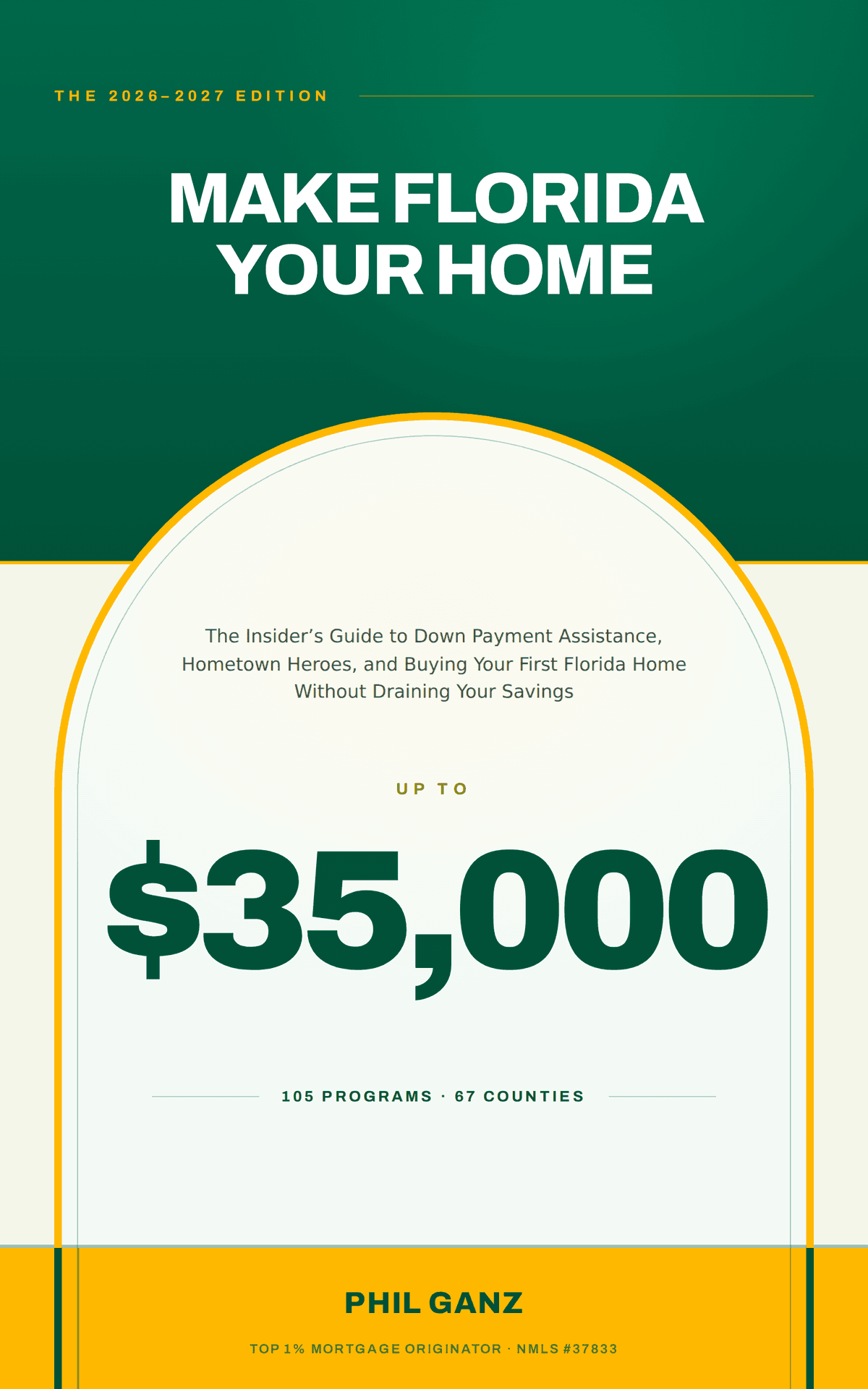
Make Florida Your Home — The Book
The insider's guide to down payment assistance, Hometown Heroes, and buying your first Florida home without draining your savings. 105 programs, 67 counties, and a 90-day plan — in plain English, from a top 1% mortgage originator.
Find Out How Much DPA You Qualify For
Check your eligibility in minutes — no credit pull, no obligation.