

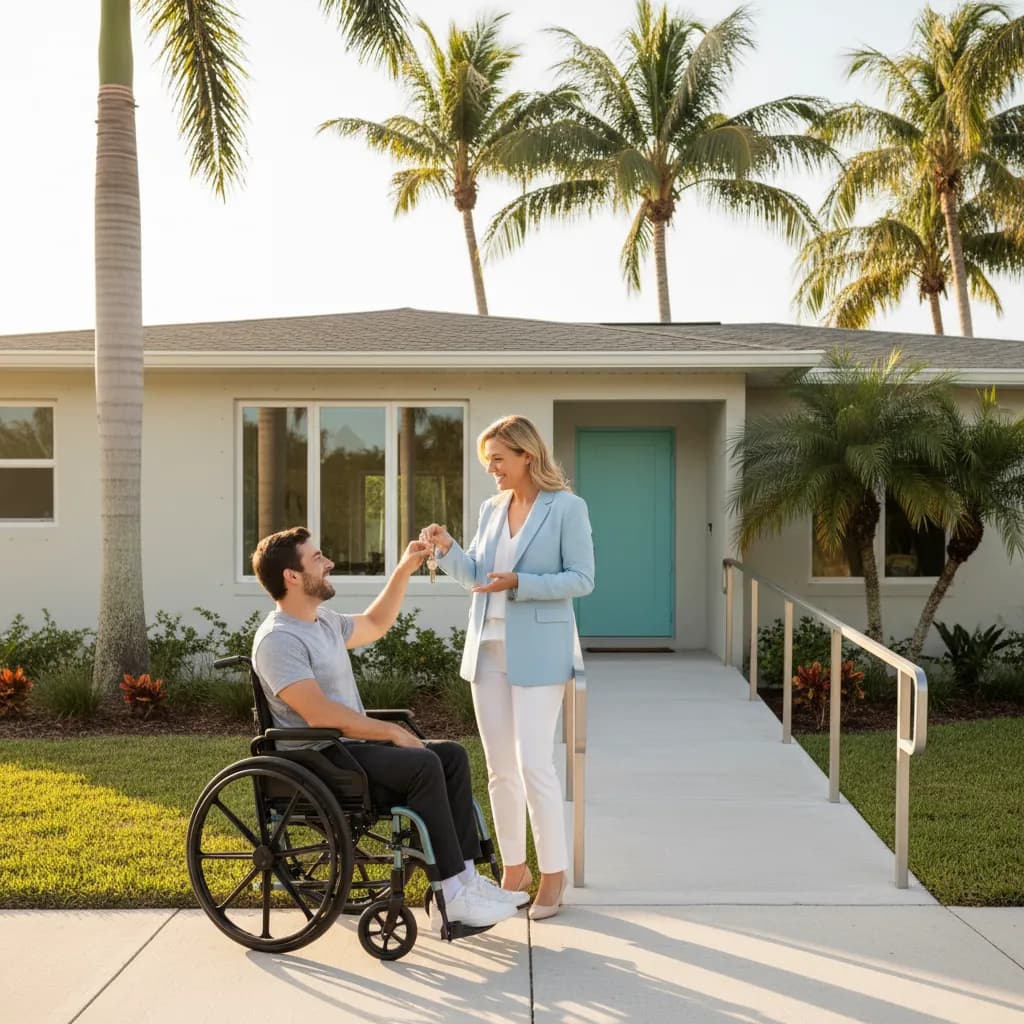
Purchasing a home in Florida while receiving disability benefits is absolutely achievable. Most lenders accept SSDI, SSI, VA disability compensation, and other disability income sources — and Florida offers multiple grants and programs specifically designed to help.
This guide covers the best loan options, grants, and down payment assistance available to disabled homebuyers in Florida right now. For a complete overview of every program in the state, see our master guide to Florida first-time homebuyer grants and programs.
See Which Florida Programs You Qualify For
Can You Buy a Home on Disability Income in Florida?
Yes. Most lenders accept:
- SSDI (Social Security Disability Insurance)
- SSI (Supplemental Security Income)
- VA disability compensation
- Long-term disability insurance
- Pension or retirement disability income
The Fair Housing Act requires lenders to treat disability income identically to employment income and prohibits discrimination based on disability status.
Key Documentation (2026)
Lenders typically require:
- SSA Award Letter or Benefits Verification Letter
- Income with no expiration date, or documented to continue at least 3 more years (lenders may not treat a routine medical re-evaluation as evidence benefits will end)
- Recent bank statements showing deposits
Parents or guardians purchasing for disabled adult children must provide the same documentation.
See Which Florida Programs You Qualify For
Best Home Loan Options for People With Disabilities in Florida
FHA Loans
Why it works: Low down payment and flexible credit rules
- Minimum credit score: 580
- Down payment: 3.5%
- Accepts SSI & SSDI income
- Higher DTI ratios allowed
Why disabled buyers use this: FHA is one of the most disability-friendly loan programs because it explicitly accepts SSDI and SSI as qualifying income with no penalty. Many disabled buyers have limited work history or gaps in employment — FHA's flexible credit and income guidelines accommodate that. The low 3.5% down payment is critical when disability benefits are your primary income and savings are limited. FHA also allows the full down payment to be covered by gift funds or DPA programs, meaning some disabled buyers close with zero out-of-pocket.
VA Loans (Disabled Veterans)
Why it works: No down payment and no monthly mortgage insurance
- 0% down payment
- VA funding fee often waived for disabled veterans
- No PMI
- Flexible underwriting
Why disabled veterans use this: Veterans with a service-connected disability rating of 10% or higher get the VA funding fee completely waived — saving $3,000–$6,000+ at closing. Disabled veterans may also qualify for significant Florida VA disability property tax exemptions that further reduce long-term housing costs. Combined with zero down payment and no PMI, this makes VA the lowest-cost loan available. VA disability compensation is tax-free, and many lenders "gross it up" — typically 15%–25% — when calculating your debt-to-income ratio, meaning your $2,000/month VA disability payment can count as up to $2,500. The exact percentage varies by lender, and VA's residual-income test always uses your actual income — but the DTI boost still significantly increases purchasing power compared to other loan types.
USDA Loans
Why it works: 100% financing for rural and suburban Florida areas
- No down payment
- Reduced mortgage insurance
- Income limits apply
- Property must be USDA-eligible
Why disabled buyers use this: USDA's zero down payment removes the biggest barrier for buyers living on fixed disability income. Many disabled buyers relocate to lower-cost suburban and rural areas in Florida where their benefits stretch further — and those are exactly the areas USDA covers. USDA also has a medical expense deduction: if your disability-related medical costs exceed a threshold, they can be subtracted from your income calculation, helping you stay within the program's income limits. Monthly mortgage insurance is also lower than FHA, keeping your payment more manageable on a fixed budget.
Fannie Mae HomeReady
Why it works: Allows household income and co-borrower flexibility
- 3% down payment
- 620 minimum credit score
- Accepts disability income
- Reduced PMI
Why disabled buyers use this: HomeReady is uniquely valuable for disabled buyers who live with family or caregivers. It gives underwriting credit for non-borrower household income (like a parent's or spouse's earnings) as a compensating factor — even if that person isn't on the loan. This is a game-changer for disabled adults who rely on a caregiver's financial support but want to own the home in their own name. HomeReady also accepts disability income and offers reduced PMI, keeping monthly costs lower than standard conventional loans.
Florida Housing Grants & Programs for People With Disabilities (2026)
Florida Hometown Heroes Program
Estimated Savings: Up to $35,000
- 0% deferred second mortgage — minimum $10,000, up to $35,000
- Down payment + closing cost assistance
- Lower first-mortgage rates
- Must be employed (or recently employed) in Florida
- Funded in annual cycles and awarded first-come, first-served — apply early in the cycle
Why disabled buyers use this: Many people with disabilities work part-time or full-time in eligible professions — healthcare workers, teachers' aides, social workers, and government employees all qualify. Veterans with disabilities are automatically eligible regardless of first-time buyer status. The $35,000 in assistance with zero interest and no monthly payments means disabled buyers can preserve their savings for medical expenses, home modifications, or accessibility upgrades after purchase.
HUD Section 8 Homeownership Voucher
Estimated Savings: Up to 30% of adjusted income
- Converts rental vouchers into homeownership assistance
- Covers mortgage payments, taxes, and insurance
- Administered by local PHAs
Why disabled buyers use this: This program was specifically designed with disabled households in mind. If you already receive Section 8 rental assistance, you can convert that voucher into homeownership assistance — the voucher pays a portion of your mortgage instead of rent. Disabled participants get a major advantage: there's no time limit on how long you can use the voucher for homeownership, while non-disabled participants are capped at 15 years. This makes it one of the most powerful long-term affordability tools for disabled buyers on fixed incomes.
MDEAT Homeownership Assistance Program (Miami-Dade)
Estimated Savings: Up to $28,500
- Zero-interest deferred loan for down payment and closing costs
- No monthly payments; forgivable after long-term occupancy
- First-time buyers in Miami-Dade County, income up to roughly 140% AMI
Why disabled buyers use this: The Miami-Dade Economic Advocacy Trust's Homeownership Assistance Program (HAP) has helped more than 11,000 families buy in Miami-Dade since 1995. The up-to-$28,500 in assistance carries no interest and no monthly payment, which matters when your budget is built around fixed disability income. It's designed for buyers who plan to stay long-term — which aligns with how most disabled buyers purchase: as a permanent, stable residence rather than a stepping stone.
FL Assist Second Mortgage
Estimated Savings: $10,000
- 0% interest, no monthly payments
- Repaid only when you sell, refinance, or pay off the mortgage
- Available statewide, year-round
Why disabled buyers use this: FL Assist is the state's always-available backstop — unlike Hometown Heroes, it doesn't run out of annual funding. The $10,000 deferred second mortgage carries no interest and adds nothing to your monthly payment, which is exactly what a fixed-income budget needs. It pairs with FHA, VA, USDA, and conventional first mortgages through Florida Housing's participating lenders. See our full FL Assist breakdown for how the repayment works.
Own a Home Opportunity Program
Estimated Savings: $10,500–$17,500
- 0% deferred second mortgage, no monthly payment
- $10,500 in Charlotte, Collier, DeSoto, Lee, and Sarasota counties; $17,500 in Palm Beach County
- 640 minimum credit score; pairs with FHA, VA, and USDA first mortgages
Why disabled buyers use this: The deferred, no-payment structure is ideal for buyers on fixed disability income who can't afford additional monthly obligations. The assistance covers most or all closing costs on moderately priced homes in Southwest Florida and Palm Beach County, with no interest accruing while you live there. Disabled veterans and buyers purchasing in HUD-designated targeted areas can qualify even if they've owned a home before — a common exemption that benefits disabled buyers who previously owned but had to sell due to changing accessibility needs.
Good Neighbor Next Door (GNND)
Estimated Savings: 50% off purchase price
- HUD-owned homes in revitalization areas
- Teachers, firefighters, EMTs, law enforcement
- 36-month owner-occupancy requirement
Why disabled buyers use this: While GNND requires employment in specific professions, disabled individuals working as teachers, EMTs, firefighters, or law enforcement officers can access a 50% discount on HUD-owned properties — one of the largest single savings of any housing program in the country. For a disabled teacher buying a $200,000 home, that's $100,000 in instant equity. Be realistic about inventory, though: only FHA-foreclosed homes in HUD revitalization areas qualify, each is listed for just seven days on hudhomestore.gov, and Florida often has few or no listings at a given moment — treat GNND as a patience-required bonus, not a plan.
Section 811 Supportive Housing
Estimated Savings: Income-based affordability
- Rental housing with supportive services
- For very low-income adults with disabilities
- Not a purchase program, but critical housing support
Why disabled buyers should know about this: Section 811 is the only federal housing program exclusively for people with disabilities, and Congress funded it at $287 million for fiscal year 2026 — a $30 million increase. While it's a rental program — not a purchase program — it's included here because it's often a critical stepping stone. Section 811 provides deeply subsidized rent (typically 30% of income) in accessible, integrated community housing with access to supportive services. For disabled individuals who aren't yet ready to buy, Section 811 can help you stabilize housing costs and save toward eventual homeownership through one of the purchase programs above.
Conclusion: Homeownership Is Possible With the Right Strategy
Disability status does not disqualify individuals from home ownership in Florida. The state offers robust combinations of mortgage programs, grants, and down payment assistance options — and many disabled buyers qualify as first-time homebuyers with access to even more programs.
When disability income is properly documented and paired with appropriate loan products, many buyers can purchase with minimal out-of-pocket costs.
Success requires understanding which loans accept your income, which grants apply in your area, and how to legally combine multiple programs. We also publish specialized guides for other groups navigating similar challenges, including Florida home loans for single moms.
See Which Florida Programs You Qualify For
For parents purchasing a home for a disabled adult child, the Florida Family Opportunity Mortgage offers owner-occupied rates without investment-property pricing — see our full guide for how it works.
Ready to Get Started?
Check your eligibility in under 2 minutes. No credit pull, no obligation.
Get our Florida updates in your Google feed
Add Make Florida Your Home as a preferred source to see our rate, grant, and program updates more often in Google Search.