The Phil Ganz Mortgage Library
New ReleaseAPPROVED: The Mortgage Playbook Your Bank May Never Show You
One bank's no isn't the end of your house search. 48 real buyer questions, each with a 30-second answer — and the programs your bank may never mention.

Written by Phil Ganz, Mortgage Expert · NMLS #37833
Published September 12, 2026 · Page updated September 15, 2026

All three formats ship from Amazon. More retailers are on the way.

Written to HUD Handbook 4000.1. The program rules described in the book are federal and apply nationwide; lender overlays vary, which is the point.
Who This Book Is For
The people the bank's box doesn't fit
A denial means the file didn't fit one lender's box. The book is for everyone standing outside it.
- Buyers a bank has already told no
- First-time buyers who assume they can't qualify yet
- Self-employed borrowers whose tax returns undersell the business
- Families gifting a down payment or co-signing to help someone qualify
- Buyers with student loans, thin credit, or no credit score at all
- Anyone comparing FHA against conventional, VA, or USDA
- Parents buying for an adult child, or children buying for a parent
- Realtors and loan officers who want the deal-saver playbook
Inside the Book
One bank's no isn't the end of your house search. It means one loan structure at one lender didn't work — not that homeownership is impossible. You might need a different loan, a different way to show your income, or a lender whose menu includes something your bank's doesn't.
APPROVED puts 48 real buyer questions into four parts. You start with why you were told no, work through the FHA deal-savers, explore the hidden menu beyond FHA, and finish with a playbook for your next conversation. Every question gets a 30-second answer up front, then the explanation in short sections with real dollar figures and the arithmetic shown, so you can open straight to the problem you're facing.
The question running through the whole book is simple: is that a HUD rule, or is that this lender's rule? Banks have different menus, and you need to know which limit you're actually hearing.
“You deserve to understand why you were turned down before you decide what to do next.”
What Readers Will Learn
48 Questions, in the Order Buyers Ask Them
Every chapter title is a real buyer's question, and the first paragraph answers it. Four parts take you from the day the bank says no to the day you sign.
Why You Were Told No
What a denial actually means, who decides an approval, and why your bank's box is smaller than the rulebook.
- 1The Bank Said No. Now What?
- 2Why Your Bank's Box Is Smaller Than the Rulebook
- 3Is FHA Really the Loan of Last Resort?
- 4What Actually Decides an Approval?
- 5Why Doesn't My Broker Just Find the Lowest Rate?
- 6Is Conventional Always Cheaper Than FHA?
The FHA Deal-Savers
The flexibilities most buyers never hear about: gift funds, co-borrowers, seller credits, income the computer missed, and more.
- 7Can I Really Buy With 3.5% Down?
- 8Can Someone Help Me Qualify Without Moving In?
- 9Co-Signer or Co-Borrower: What's the Difference?
- 10Can My Family Just Give Me the Money?
- 11How Much Can the Seller Pay?
- 12Lower Price or Seller Credit: Which One Actually Saves Me Money?
- 13What Is Down Payment Assistance, and Can I Stack It With FHA?
- 14Why Would I Ever Choose an Adjustable Rate?
- 15Can My First Home Be a Fourplex?
- 16The Appraisal Found Repairs. Does Closing Really Stop?
- 17The Computer Said "Refer." Am I Done?
- 18Is 43% Really the Maximum DTI?
- 19Do Student Loans Kill My Mortgage?
- 20Does Overtime Count?
- 21When the Paystub Tells the Wrong Story
- 22Can Untaxed Income Count for More?
- 23Can a Roommate Help Me Qualify?
- 24I'm on Leave. Can I Still Qualify?
- 25I Have No Credit Score. Is That a No?
- 26How Long After a Bankruptcy or Foreclosure?
- 27The Condo Isn't FHA-Approved. Now What?
- 28Can I Get FHA on a Manufactured Home?
- 29The House Needs Work. Do I Walk Away?
- 30Should I Just Build It?
- 31Can I Take Over Someone's Low-Rate Mortgage?
- 32What Is a 2-1 Buydown, Really?
The Hidden Menu Beyond FHA
The programs your bank may not offer at all: zero-down loans, self-employed workarounds, and buying for family.
- 33HomeReady, Home Possible, HomeOne
- 34Zero Down: VA
- 35Zero Down: USDA
- 36I'm Self-Employed and My Tax Returns Look Bad
- 37I Have Assets, Not Income
- 38When the Property Qualifies More Than You Do
- 39Buying a Home for a Parent or an Adult Child
- 40I Already Own a Home and Want Another
- 41Doctors, Nurses, Teachers, First Responders
- 42Should I Refinance or Get a HELOC?
- 43Reverse Mortgages, Briefly
- 44Buying After a Divorce
- 45Getting Your Credit Mortgage-Ready
The Playbook
Turning everything above into your next conversation, with checklists and the exact questions to ask.
- 46The APPROVED Checklist
- 47Questions to Ask Any Loan Officer
- 48Think You Were Told No Too Quickly?
Free Resources That Go With the Book
The book is national. These guides and tools cover the Florida specifics and the next step, and they are free with or without it.
Check FHA Loan Eligibility
See whether the FHA structures in the book fit your file. Two minutes, no credit pull.
Florida Down Payment Assistance
Chapter 13 asks whether DPA stacks with FHA. Here is every Florida program that can.
Down Payment Assistance Calculator
The county-by-county calculator behind the book's assistance examples. Free, no signup.
First-Time Home Buyer Guide
The Florida-specific companion to Part I: programs, timelines, and first steps.
FHA Loans in Florida
Requirements, limits, and the Florida details that sit alongside the book's national rules.
Talk With Phil's Team
Bring the questions from Chapter 47. A licensed loan officer will answer them.

4.9 ★ · 100+ Google Reviews
NMLS #37833 · Verify on NMLS Consumer Access
About the Author
Phil Ganz, Author of APPROVED
Mortgage Expert · NMLS #37833 · President, Next Wave Mortgage
Why I Wrote This Book
“Every week I close loans for buyers another lender turned down. Not because I'm a magician — because their file never needed magic. It needed a different loan, a different way to document the same income, or somebody willing to check whether the rule was HUD's or just that bank's.”
Phil Ganz is a nationally ranked top 1% mortgage originator and President of Next Wave Mortgage (NMLS #2536820), the Fort Lauderdale-based lender behind MakeFloridaYourHome.com. Over 26+ years in the mortgage industry he has helped thousands of families through the biggest financial decision of their lives.
He wrote APPROVED because the most expensive sentence in home buying is “the bank said no, so we stopped looking.” The 48 questions in the book are the ones real buyers ask after a denial, answered the way he answers them across the desk: the 30-second version first, then the explanation with the arithmetic shown.
Phil holds individual NMLS license #37833 and specializes in home financing for Florida families, including FHA loans, first-time buyers, and down payment assistance.
Read Phil's full profileChoose Your Edition
Same book in every format.
Paperback
The everyday print edition. 389 illustrated pages.
Buy on AmazonHardcover
Durable and gift-ready.
Buy on AmazonKindle eBook
Instant delivery. Read on any device.
Buy on AmazonPublication Details
APPROVED: The Mortgage Playbook Your Bank May Never Show You · Published September 12, 2026 · Author: Phil Ganz · Publisher: Phil Ganz · 389 pages
Paperback ISBN 979-8173583147 · Hardcover ISBN 979-8173583840 · Kindle ASIN B0HJLMGJZY
Where to Buy
APPROVED is stocked wherever you already buy books. Every link opens the retailer in a new tab.
Buy the Book

More retailers are added as each one lists the title.
Also by Phil Ganz
More from the Mortgage Library
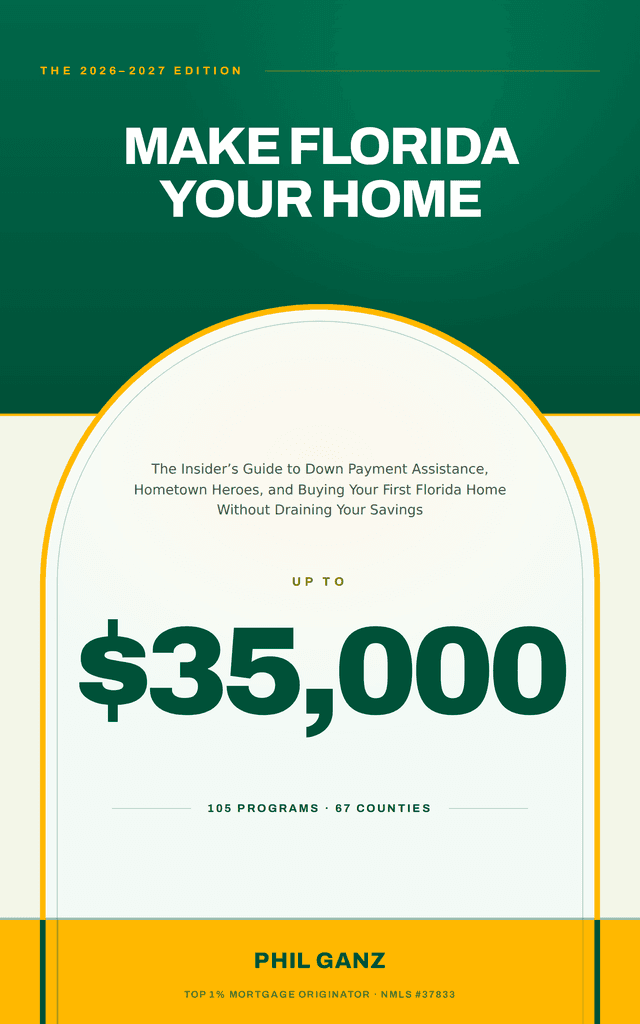
Make Florida Your Home
For Florida buyers who want to understand grants, down payment assistance, and first-time homebuyer programs.

The Reverse Mortgage Inheritance Strategy
For adult children and families trying to understand how a parent's reverse mortgage affects the house, the inheritance, and everyone's money.
Questions Buyers Ask After the Bank Says No
Short answers to the questions the book answers in full. The program rules below are federal and apply nationwide.
Talk to an ExpertAPPROVED is a consumer guide to what a mortgage denial actually means and what to do next. It puts 48 real buyer questions into four parts: why you were told no, the FHA deal-savers, the loan programs beyond FHA that your bank may not offer, and a playbook for your next lender conversation. Each chapter opens with a 30-second answer, then explains the rule with real dollar figures. It is educational, not a loan offer.
Yes. The FHA minimum down payment is 3.5 percent of the purchase price for borrowers who meet the program's credit requirements, and the entire amount can come from an allowable gift rather than your own savings. The book walks through what counts toward the 3.5 percent, how gift funds are documented, and how seller credits can cover closing costs on top of it.
Yes. FHA allows gift funds from family members and other approved donors to cover the entire down payment. The catch is the paperwork: HUD's definition of family does not include everyone you consider family, so the same gift can require different documentation depending on who gives it and how the relationship is labeled. Chapter 10 covers the gift letter, the paper trail, and the labeling traps that stall closings.
Often, yes. FHA permits non-occupant co-borrowers, meaning a parent or other qualifying person can be on the loan and lend you their income and credit without living in the house. The book explains how it works, what the co-borrower is actually committing to, and the difference between a co-signer and a co-borrower.
It depends on the program. FHA and USDA allow seller contributions up to 6 percent of the price, conventional loans allow 3 percent at the lowest down payments (more as your down payment grows), and VA allows all customary closing costs plus a separate 4 percent concession that can even pay off the buyer's debts. Chapter 11 compares all four side by side, and Chapter 12 shows when a seller credit beats a lower price.
First, get the specific reason in writing. Then ask the question the book is built around: is that a HUD rule, or is that this lender's rule? Many denials are one lender's overlay, a stricter in-house standard sitting on top of the actual program rules, which means a different lender can approve the same file. Part IV gives you the APPROVED Checklist and the exact questions to ask the next loan officer.
No. FHA gets the deepest treatment because it saves the most denied deals, but Part III covers the menu beyond it: HomeReady, Home Possible, and HomeOne, zero-down VA and USDA loans, bank statement and asset-based programs for the self-employed, buying for a parent or adult child, and professional programs for doctors, nurses, teachers, and first responders.
Yes. Self-employed borrowers can qualify for the same conventional and FHA loans as anyone else, and when tax write-offs make the returns look thin, there are bank statement and asset-based programs designed for exactly that file. The book explains how underwriters read self-employment income and which alternatives exist when the standard math doesn't work.
No. The rules in the book are federal program rules, written to HUD Handbook 4000.1, and they apply nationwide. Florida-specific details, like the state's down payment assistance programs and county-level examples, are covered free on this site.
The content is identical across editions. The paperback and hardcover are the illustrated print editions on Amazon, and the Kindle edition delivers instantly to any device. More retailers are being added as each one lists the title.
Told No? Get a Second Opinion
A licensed loan officer will look at your actual file and tell you which programs fit — and whether that no was a program rule or just one bank's rule. No credit pull, no obligation.