

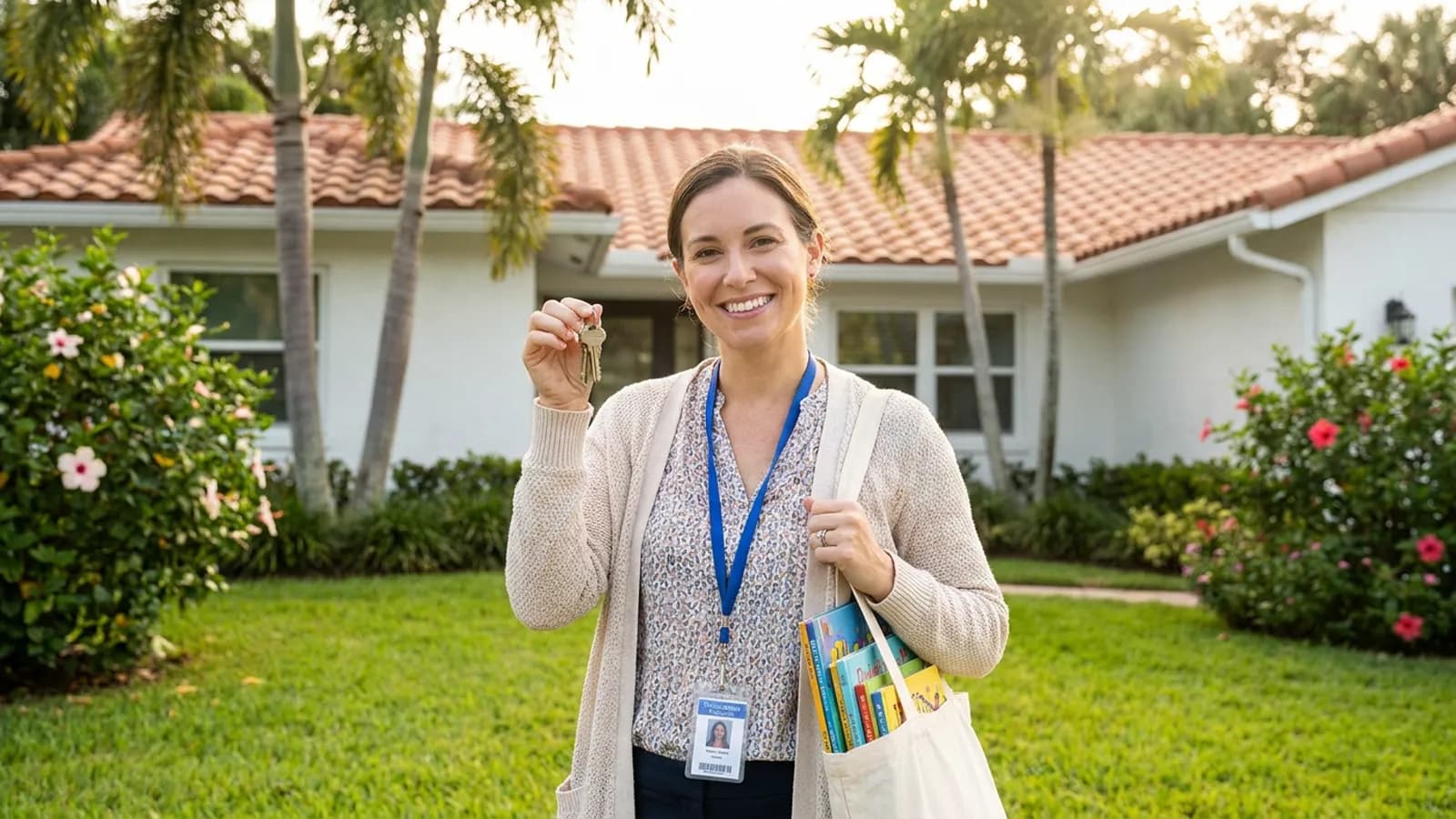
Teachers have steady jobs, but a 10-month pay schedule, coaching stipends, and student loans can make a mortgage application look harder than it really is.
This guide covers the home loans that fit Florida teachers and school staff, how lenders count your contract pay, and which programs can help with your down payment.
Check Your Florida Home Purchase Eligibility as a Teacher
By the end, you'll know which loan to ask about, what paperwork to gather, and how much help you may be able to stack at closing.
Florida Home Buying Programs for Teachers
Florida doesn't have a teacher-only mortgage. Teachers use the same home loans as other buyers, then add programs built for public servants. These are the main ones.
| Program | What You Get | Who Qualifies |
|---|---|---|
| Florida Hometown Heroes | 5% of your loan, $10,000 to $35,000, for down payment and closing costs | Full-time staff at Florida K-12 schools, first-time buyers, 640+ credit |
| HUD Good Neighbor Next Door | 50% off eligible HUD homes, $100 down with FHA | Full-time pre-K to 12 teachers; limited homes in revitalization areas |
| County and city programs | Forgivable or deferred down payment loans | Varies by county, with income limits |
| FHLBank Atlanta Community Partners | Down payment help through member banks and credit unions | Educators and other public servants, with income limits |
Each program is explained below, after the loan options it pairs with.
Best Home Loans for Teachers in Florida
There's no special mortgage for teachers, so most teachers buy with a standard home loan and then add down payment help on top. Here's how the main options compare.
| Loan | Down Payment | Credit Score | Best For |
|---|---|---|---|
| FHA | 3.5% | 580+ | Newer teachers with student loans or lower credit scores |
| Conventional | 3% | 620+ | Good credit; mortgage insurance can be removed later |
| USDA | 0% | Set by lender | Teachers buying in eligible rural and suburban areas |
| VA | 0% | Set by lender | Teachers who served in the military, Guard, or Reserve |
| Hometown Heroes | Up to $35K | 640+ | First-time buyers working full-time at a Florida K-12 school |
FHA is often the easiest approval for teachers carrying student loans, because it allows higher debt-to-income ratios. Conventional usually costs less over time once your credit is in the 700s. Teachers in smaller towns should check USDA loans in Florida, which require no down payment in eligible areas. See the full Florida FHA loan requirements for credit, DTI, and down payment rules.
How Lenders Count Teacher Income
School pay is predictable, but it's structured differently from most jobs. Here's how each piece is usually handled.
- Contract salary: Lenders use your annual contract amount, divided by 12. It doesn't matter whether your district pays you over 10 months or spreads it over 12. Your contract, recent paystubs, and a verification of employment from the district confirm it.
- Summer months: Closing in July is fine. A signed contract for the coming school year shows your income continues, even if your last paycheck came in June.
- Coaching, summer school, and tutoring: These usually count once you have about a two-year history, averaged over that time. A new stipend this year may not count yet.
- Contract supplements: Pay built into your contract, such as supplements for certifications or extra duties, may count right away if it's guaranteed for the school year.
- New teachers: College generally counts toward your work history. Some conventional loans can close on a signed contract if you start soon after closing, usually with extra cash reserves.
- Changing schools or districts: Moving to another school in the same role is usually fine, even mid-application, as long as your pay is similar.
Example: Say you have a $52,000 teaching contract. That's about $4,333 a month, no matter how your district spreads your paychecks. If you've earned a $3,000 coaching stipend for the last two years, the lender may add $250, for about $4,583 a month. At a 45% debt-to-income ratio, with a $350 car payment and a $120 student loan payment, that leaves room for a housing payment of roughly $1,590 a month, including taxes and insurance.
See What You Qualify For as a Florida Teacher
Student Loans and Your Mortgage
Student loans are the biggest reason teachers qualify for less than they expect. The payment a lender counts depends on the loan type:
- FHA: uses the monthly payment on your credit report. If it shows $0, FHA uses 0.5% of your loan balance instead, so $40,000 in student debt counts as $200 a month.
- Conventional (Fannie Mae): can use a documented $0 payment on an income-driven repayment plan.
If you're on an income-driven plan, this difference can change which loan approves you for more. A loan officer can run your file both ways before you choose.
Florida Hometown Heroes for Teachers
Once you know which loan fits, down payment programs can cut the cash you need to close. Florida Hometown Heroes is the biggest program for Florida teachers. It covers classroom teachers, teacher aides, principals, counselors, librarians, school psychologists, cafeteria and maintenance staff, and other employees of Florida-based K-12 public, private, charter, and magnet schools.
- Amount: 5% of your first mortgage, from $10,000 up to $35,000, for down payment and closing costs
- Terms: a 0% interest, 30-year deferred second mortgage with no monthly payment. It is not forgiven; you repay it when you sell, refinance, or stop living in the home.
- Requirements: first-time buyer (veterans are exempt), 640 or higher credit score, full-time employment at a physical Florida location when you close, and county income limits
- Funding: eHousingPlus listed over $20 million available in November 2026. Your lender should confirm availability before you count on it.
College and university employees don't qualify, including instructors teaching dual-enrollment courses. Pre-K teachers at licensed child care centers can qualify under the childcare category. See the full Hometown Heroes job eligibility list to check your role.
Good Neighbor Next Door for Teachers
HUD's Good Neighbor Next Door program is one of the largest discounts available to teachers, but it only works for certain homes.
- Who qualifies: full-time teachers at state-accredited public or private schools serving pre-K through 12th grade. Your school must serve students from the area where the home is.
- The discount: 50% off the list price of eligible HUD-owned homes in HUD revitalization areas, with as little as $100 down when you finance with FHA.
- The catch: you sign a no-payment second mortgage for the discount and must live in the home as your only residence for 36 months. You can only use the program once.
Available homes are limited and listed weekly, so it works best as something to watch alongside a regular home search, not a replacement for one.
Teacher Next Door
Teacher Next Door is a private national program run by Teacher Next Door, LLC. Despite the similar name, it is not HUD's Good Neighbor Next Door, and it is not a State of Florida program. Financing goes through the program's own preferred lenders.
If you get a Teacher Next Door offer, ask which part is a true grant and which part is a second mortgage, then compare the full cost against Hometown Heroes and your local programs.
County and Bank Programs
Many Florida counties and cities run their own down payment programs through SHIP and HOME funds, often as forgivable or deferred loans. Some can be combined with Hometown Heroes. Our Florida first-time homebuyer grants and programs guide lists them by area.
Some Florida banks and credit unions also offer FHLBank Atlanta's Community Partners program, which provides down payment help for educators and other public servants. Amounts vary by institution, and buyers typically need to contribute at least $1,000, complete homebuyer education, and meet income limits.
Check Your Florida Home Purchase Eligibility as a Teacher
Can You Combine Programs?
Often, yes. A common Florida setup is an FHA or conventional first mortgage plus Hometown Heroes, with seller credits covering part of the closing costs. Some county programs can be layered on top as well. Good Neighbor Next Door has its own rules, so check with your lender before combining it with other assistance.
Every program has its own rules about which first mortgage it works with, income limits, and occupancy. A loan officer who works with Florida programs can check which ones fit your county and price range before you make an offer.
What to Gather Before You Apply
Having these ready speeds up pre-approval:
- Your current teaching contract, and next year's if it's signed
- Paystubs covering the last 30 days
- W-2s from the last two years
- Two months of bank statements
- Records of coaching, summer school, or tutoring pay, if you want it counted
- Your student loan statements, including your repayment plan
Florida Costs to Plan For
Your mortgage payment is only part of the cost of owning a home in Florida. Homeowners insurance, and flood insurance in some areas, can add several hundred dollars a month. Condo buyers should also check the building's reserves and any special assessments; our Florida condo loan guide explains what lenders review.
After you move in, file for the Florida homestead exemption by March 1 to lower your property taxes.
Getting Started
The best first step is a pre-approval that shows which loan and programs you qualify for, based on how your contract and side income are actually structured.
Next Wave Mortgage works with teachers and school staff across Florida and can compare FHA, conventional, USDA, and VA options side by side with Hometown Heroes. Other public servants can read our guides to home loans for nurses and first responder home loans in Florida.
See If You Qualify for a Florida Home Loan as a Teacher
Teacher Next Door is not administered by the State of Florida or HUD. Assistance amounts and availability change and are not guaranteed. All loans are subject to credit approval and program guidelines.
Ready to Get Started?
Check your eligibility in under 2 minutes. No credit pull, no obligation.
Get our Florida updates in your Google feed
Add Make Florida Your Home as a preferred source to see our rate, grant, and program updates more often in Google Search.