

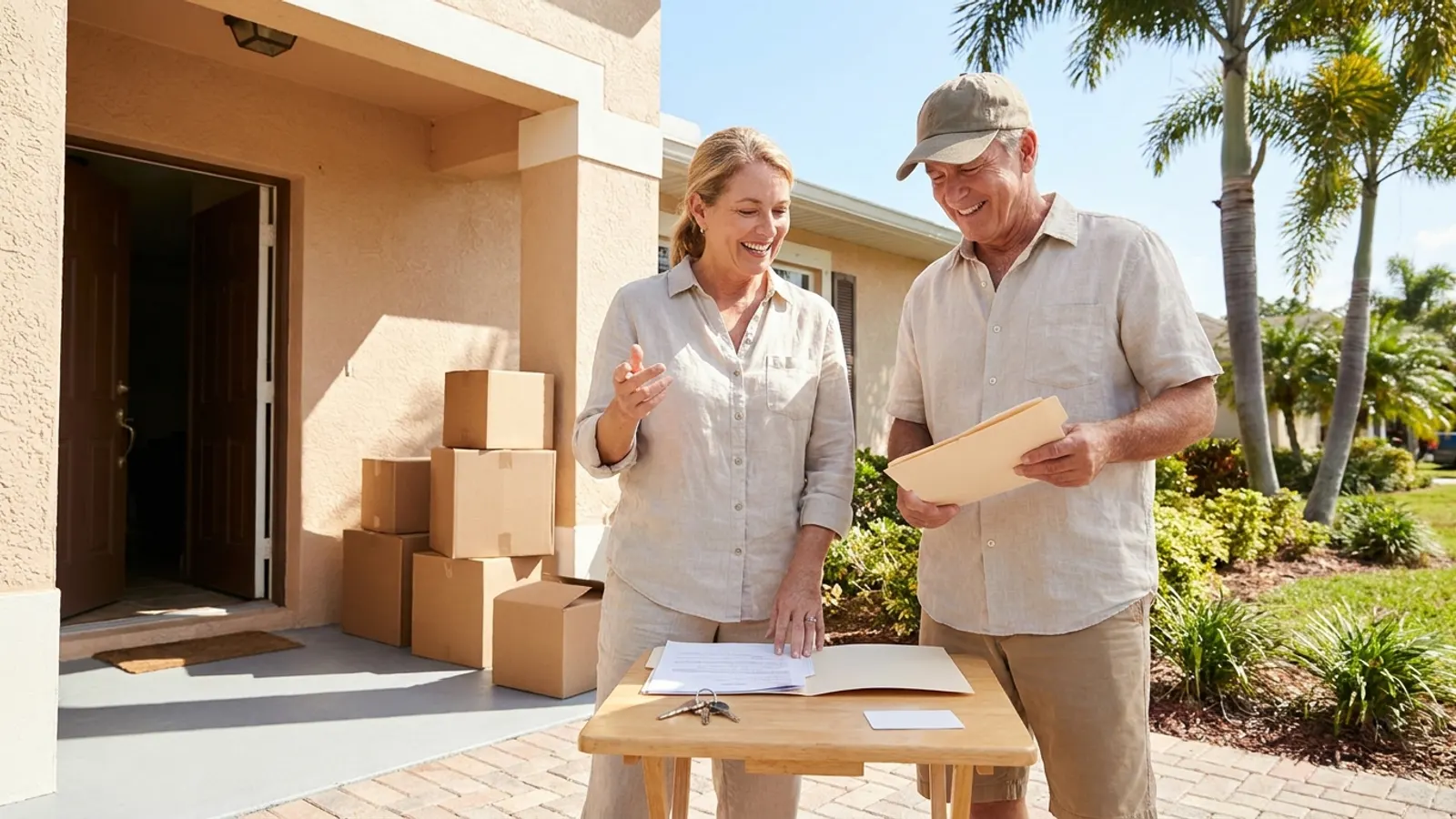
If you're thinking of making Florida your legal home, it takes a little more than packing your bags and moving to the Sunshine State.
This step-by-step guide covers how to establish Florida residency, including the documents you need, the deadlines that apply, and how to show your move is permanent.
Check Your Florida Home Purchase Eligibility as a New Resident
You'll also learn why December 31, 2026 matters if you plan to buy a Florida home, now or later.
Florida Residency at a Glance
- No statewide waiting period: you can become a resident when you live in Florida and intend to stay permanently.
- Your actions prove your intent: a Florida home, driver license, vehicle registration, voter registration, and Declaration of Domicile all support your claim.
- No 183-day rule in Florida: day counts matter mostly to the state you're leaving.
- A deadline this year: being a permanent Florida resident by December 31, 2026 can mean a much larger homestead exemption when you buy. More on that below.
The Step-By-Step Guide to Florida Residency
To establish Florida residency, complete these four steps. Start with your home, since the other steps ask for your Florida address.
Step 1: Establish a Home in Florida
Secure a residence in Florida by buying a home or renting one, and move in. Then update your mailing address for state and federal tax purposes. You can use IRS Form 8822 to tell the IRS about your new address.
If you buy, apply for the Florida homestead exemption by March 1. It lowers your property taxes and helps show that Florida is your permanent home. Florida seniors may qualify for additional property tax exemptions.
Step 2: File the Florida Declaration of Domicile
A Declaration of Domicile is a sworn statement that Florida is your permanent home. Under Florida Statute 222.17, you file it with the clerk of the circuit court in the county where you live.
It states your Florida address, where you lived before, and any other homes you keep. If you have a home in another state, it also says your Florida home is your predominant and principal home.
Filing doesn't make you a resident by itself, but it's a simple way to document your intent. Your county clerk can tell you about its form, notary requirements, and recording fee.
Domicile vs. residence: you can have homes in more than one state, but only one domicile. Your domicile is the place you consider your permanent home and intend to return to.
Step 3: Get a Florida Driver License and Register Your Vehicle
You must get a Florida driver license within 30 days of establishing residency if you plan to drive here. If you don't drive, get a Florida ID card instead.
Apply in person and bring:
- Proof of identity
- Proof of your Social Security number
- Two different documents showing your Florida address, such as a lease, deed, mortgage statement, or a utility bill dated within the last 60 days
You'll take a vision test, but you may not need a written or road test. A first-time Class E license costs $48 and an ID card costs $25. Most tax collector offices add a $6.25 service fee. The state's U.S. citizen document list has the full details, and separate lists cover immigrants, non-immigrants, and Canadians.
Next, get Florida car insurance, then title and register your vehicle. The state's deadline is 10 days from establishing residency. You'll need:
- Proof of identity and Florida insurance
- Your out-of-state title, or a lienholder's help transferring it if you have a car loan
- A completed title application and a physical VIN verification
Budget for the $225 fee that generally applies the first time a vehicle is registered in Florida. Some exceptions apply.
Step 4: Register to Vote in Florida
Registering to vote isn't required to become a resident, but it's strong evidence of your intent. You must be a U.S. citizen, a Florida resident, and at least 18. The Florida Division of Elections lets you register online, through a tax collector's office, or by mail. Cancel your old registration too, so your records all point to one state.
See If You Qualify to Buy a Home in Florida
Florida Residency Deadlines
| What | Timing | Good to know |
|---|---|---|
| Driver license | 30 days | From establishing residency, if you drive |
| Vehicle title, registration, and insurance | 10 days | From establishing residency |
| Homestead exemption | March 1 | Own and live in the home on January 1 of that tax year |
| Amendment 3 residency date | Dec. 31, 2026 | Affects the size of your future homestead exemption |
| In-state college tuition | 12 months | Consecutive legal residence before first enrolling |
How Long Do You Have to Live in Florida to Be a Resident?
There's no single answer because different agencies ask different questions.
The state's motor vehicle agency says you may be considered a resident when you have:
- Started a job or business in Florida
- Enrolled your children in public school here
- Registered to vote here
- Filed for a homestead exemption
- Lived here for more than six consecutive months
For homestead, the county property appraiser decides whether you're a permanent resident. Florida Statute 196.015 lists factors such as your Declaration of Domicile, your children's school, your job, voter registration, driver license, license tag, federal tax return address, bank statements, and utility payments. No single factor decides it.
The 183-Day Rule and Your Old State
Florida has no state personal income tax, no estate tax, and no inheritance tax, which is why many people move here for tax reasons. But becoming a Florida resident doesn't automatically end your tax ties to your former state.
The 183-day rule you've probably heard about isn't a Florida residency law. Other states use day counts to decide whether they can still tax you. New York, for example, can treat you as a resident if you keep a permanent home there and spend 184 days or more in the state, even if your domicile is elsewhere. It also counts part of a day as a full day.
If you're leaving a high-tax state, especially if you're keeping a home there:
- Learn your former state's rule before you move
- Keep a calendar, travel records, and utility bills that show where you spend your time
- Move the things that matter most to you, not just your mail
- Talk to a tax professional about your final part-year return
The December 31, 2026 Deadline for Future Homebuyers
Florida voters approved Amendment 3 on November 3, 2026, in unofficial results. It raises the homestead exemption from non-school property taxes to $150,000 in 2027 and $250,000 in 2028, but it treats newer residents differently:
- Permanent Florida residents as of December 31, 2026: the full larger exemption once you buy and qualify for homestead, even if you buy years later.
- New residents after that date: a $50,000 non-school exemption plus $25,000 for school taxes until your fifth year of homestead.
On a $400,000 home at a 1% non-school tax rate, that difference is about $2,000 a year for four years, or roughly $8,000.
You don't have to buy by December 31, but you do need to have really made the move. If you're already planning to relocate soon, get your lease or home, license, registration, and voter records in place and keep proof of your move date.
There are some unknowns. The Legislature still has to set procedures, your county property appraiser decides whether you qualify, and this rule applies only "to the extent permitted by the U.S. Constitution," so it could be challenged. Don't rush a move only for this exemption.
Check Your Florida Home Purchase Eligibility Before You Move
Additional Actions to Strengthen Your Florida Residency Claim
The four steps above form the foundation of your Florida residency. These actions can further show your commitment to the state:
- Use your Florida address on your federal income tax return
- Update your address with the Social Security Administration
- Move your main bank accounts to your Florida address or a Florida bank
- Enroll your children in a Florida school
- Find Florida doctors and get Florida health insurance
- Update your will and other estate documents with a Florida attorney
- Relocate your business, or transfer your professional license
- Cancel your old state's license, registration, and any resident tax breaks, such as a homestead exemption
The longer you live in Florida and the more of your life moves here, the stronger your claim becomes.
Buying a Home as a New Florida Resident
You don't need to own a home to become a resident, but many people move here to buy one. Here's what to know if that's your plan:
- Your job can move with you. If you're moving for a new Florida job, lenders can often work with an offer letter and your work history. Tell your loan officer early.
- Be clear about how you'll use the home. A primary residence loan generally requires you to actually move in. If Florida won't be your main home, you'd need a second home or investment loan instead.
- Plan for more than the price. Compare insurance, property taxes, and HOA dues along with your mortgage payment. Our home affordability calculator and list of the cheapest places to buy in Florida can help you narrow your search.
- Ask about assistance. Florida has grants and programs for homebuyers, and FHA loans allow as little as 3.5% down for qualified borrowers. Program rules vary.
Moving from another country? See our guides for buyers from Canada, the UK, and other countries.
Check Your Florida Home Purchase Eligibility
This guide is general information, not legal or tax advice. For a move with major tax consequences, talk to a Florida attorney or tax professional.
Ready to Get Started?
Check your eligibility in under 2 minutes. No credit pull, no obligation.
Get our Florida updates in your Google feed
Add Make Florida Your Home as a preferred source to see our rate, grant, and program updates more often in Google Search.